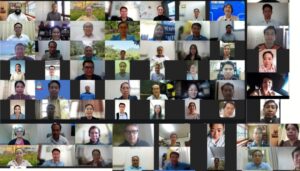
In February 2025, all the project teams were formed: REAL Programme Teams (5 in NUOL, 4 in SU, 4 in SKU & 4 in CU), REAL Institutional Units in four universities, National REAL Task Force led by MOES, REAL Steering Committee and REAL Dissemination Team.

On 11, 12, 19 and 20 February REAL Online Kick-Off Meeting sessions were conducted:

1) General project presentation,
2) Project Financial & Administrative Management,
3) First Academic Tasks Q&A session: what each REAL Programme Team needs to do BEFORE the 1st General Meeting, and
4) First Dissemination Team meeting

107 representatives of partner institutions took part in the sessions – a great start of the REAL 4-year journey!

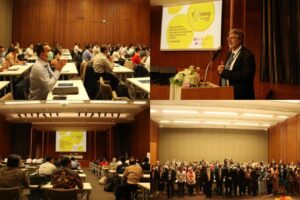
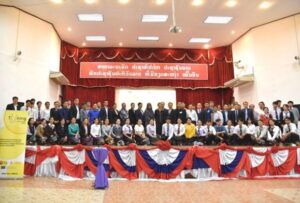
We are excited to announce that the RESET Project officially kicked off with a three-day meeting hosted by Champasack University (CU) in Pakse, Champasack Province, from March 4th to 6th, 2026.The event brought together partners from Laos and Europe to launch our shared mission: strengthening research management to accelerate Green Growth in Lao PDR.Day 1 featured warm welcomes from CU and MoES leaders, a keynote by Dr. Roberto Escarre (UA, Spain), institutional presentations, and a networking dinner.Day 2 was dedicated to intensive work package discussions, covering Management, Training, Research Hubs, and more, with all partners sharing insights.Day 3 focused on sustainability with sessions on Strategic Policy and Dissemination, plus a Stakeholder Workshop to plan future engagement.A huge thank you to Champasack University for hosting and to all partners for their enthusiasm. The RESET project is now ready to roll! Stay tuned for updates. #RESETProject #ErasmusPlus #GreenGrowth #HigherEducation #Laos #KickoffMeeting


3 LINES OF WORK
The CALOHEA project activities are structured around three Lines of Work, each associated with one of the 3 Key Recognition Mechanisms.
LINE 1
Regional Subject-Specific Qualifications & Assessment Reference Frameworks

Revision of Meta-Profiles
Development of Region-wide subject-specific qualifications frameworks
Comparison of desired graduate profiles with the help of the CALOHEA Reference Frameworks​

LINE 2
Student Workload Measurement

Elaboration of contextualised student workload measurement tools for the region
Consultations on Student Workload and analysis of the results
Guidelines for bridging South East Asian Student Workload with other contexts

LINE 3
Authentic Assessment of Programme
Learning Outcomes

Diagnostic of current assessment practices of learning outcomes
Development of Action plans to move towards full implementation of authentic assessment of programme learning outcomes
Creating compilations of Inspirational examples of authentic assessment of programme learning outcomes

The results of Line 1 of the project are now available on the project website, with Results of Line 3 is coming soon.
Visit the CALOHEA website to see more information: https://calohea.org/


Souphanouvong University is a partners in the CALOHEA project, joining two subject areas in this project such as Teacher Education and Civil Engineering.

The names of the members of our CALOHEA Institutional Team are as follows:

  1. Teacher Education Team

1        Team Lead  Mr. Sianouvong  Savathvong      Sianouvong@su.edu.la

2        Deputy Lead Dr. Sangkhom Inthapanya     inthapanyasangkhom@gmail.com

3        Coordinator Ms. Somchay Makesavanh   somchaymsv@su.edu.la

4        Team Member Mr. Toulakone Souliya     Souliya_SU@yahoo.com

5        Team Member Mr. Sipaseuth Panfongphet     Sipaseuth2008@gmail.com

6        Team Member Ms. Ketsalinh Lampaiphanh          Klamphaiphanh@gmail.com

7        Team Member Mr. Thavone Panmanivong          thavone9@gmail.com

8        Team Member Mr.Thongsy   Xuamolee          thongsy_su.la@yahoo.com

  1. Civil Engineering Team

1            Team Lead  Mr. Sianouvong  Savathvong      Sianouvong@su.edu.la

2            Deputy Lead Dr. Sangkhom Inthapanya     inthapanyasangkhom@gmail.com           inthapanyasangkhom@gmail.com

3            Coordinator Ms. Somchay Makesavanh   somchaymsv@su.edu.la4

  1. Team Memb Mr. khamphoungeun  Siphaxay    khamphoungeunsiphaxay@gmail.com

5            Team Member Mr. Boualaphan Thavongsy      bay14782@gmail.com

6            Team Member Mr. Bounphong  Nanthavong  Bounphong88@gmail.com

7            Team Member Mr. Bounsana  Chansavang       chsv_nace@yahoo.com

8            Team Member Mr. Somsanouk Bounxayyavong  sssomsanouk@gmail.com

Visit the CALOHEA website to consult or download the 3 compilations – one for Medicine, one for Teacher education and one for Civil Engineering: https://calohea.org/

The CALOHEA Erasmus+ project is coordinated by the Tuning Academy of the University of Groningen (the Netherlands) and the ASEAN University Network and is co-funded by the European Commission.

CALOHEA Project
Measuring and Comparing Achievements of Learning Outcomes in Higher Education in Asia

Background of the project:
The CALOHEA project’s ultimate aim is to increase and enhance the internationalization effort of ASEAN Higher Education Institutions through degree recognition. In order to realize its goal, the project focused on establishing and systemize the implementation of three Recognition Mechanisms of study programmes.
Regional Subject-specific Qualifications and Assessment Reference Frammework
Student Workload Calculation
Authentic Assessment of Learning Outcomes
As such, in order to fully optimize the systematic use of Recognition Mechanisms, the project requires mass adoption of the mechanisms in the ASEAN region not only from inside but also outside of the Project Consortium.
General Objective:
Contribute to the internationalization of higher education institutions through developing a series of interrelated measures indispensable for improving recognition of higher education degree.
Expected Results:
3 Key Recognition Mechanisms
RM1: Creationand use of Regional Subject-Specific Qualifications and Assessment Reference Frameworks to permit greater comparability of institutional degreeprogrammeprofiles
RM2: Instalment of the culture of student workload measurement as an integral part of curriculumdesign
RM3: Implementation of authentic assessment of internationally comparable learningoutcomesin degreeprogrammes
CALOHEA Regional Subject-Specific Reference Frameworks as tools for promoting recognition and internationalisation

One of the tools created by the CALOHEA Erasmus+ project participants in order to facilitate recognition of degrees and periods of studies both within the ASEAN region and between the ASEAN region and other world regions are Regional Subject-Specific Reference Frameworks.
A Qualifications Framework is a structure that allows us to classify different qualifications in a geographical area covered by the framework and establish a broad equivalence of qualifications (e.g. first cycle of higher education/undergraduate, etc.) across the region. This is done through describing what a learner will have developed in terms of knowledge, skills, attitudes, competences, etc upon successfully completing a particular level of studies.
Regional Qualifications Reference Frameworks seek to establish broad equivalence among qualifications offered in more than one country. Such frameworks are intended to be used as Reference Documents – facilitating recognition but not overruling National regulations or National Qualifications Frameworks. The ASEAN Qualifications Reference Framework (AQRF) and the European Qualifications Framework (EQF) could be two good examples here.
CALOHEA Subject-Specific Qualifications Reference Frameworks facilitate recognition through allowing to:
1) clearly see which key dimensions must be addressed by each programme in the subject area;
2) establish equivalence between qualifications offered in different countries in terms of their level, regardless of how the qualifications are referred to in each of the countries;
3) express specialisation of a particular programme in terms of the sub-dimensions addressed;
4) compare the level of achievement aimed at for each of the sub-dimensions – in terms of knowledge, skills or responsibilities;
5) compare shorter periods of study as well – periods of study during which only particular types of knowledge, specific skills or capacity to perform particular responsibilities can be developed.
CALOHEA Regional Subject-Specific Qualifications Reference Frameworks state in a detailed manner what knowledge, skills, attitudes, competences, etc. are expected from graduates of a ARQF Level 6 degrees in Civil Engineering, Medicine and Teacher Education; & allow recognition across all the countries involved in the development of the Frameworks.
To see the CALOHEA Reference Frameworks, visit https://calohea.org/
The CALOHEA Erasmus+ project is coordinated by the Tuning Academy of the University of Groningen (the Netherlands) and the ASEAN University Network and is co-funded by the European Commission.

THE FIRST ACHIEVEMENT OF A UNIQUE ACADEMIC AND SCIENTIFIC COOPERATION BETWEEN THE UNIVERSITY OF SOUPHANOUVONG AND THE UNIVERSITY OF TOURS
Anousith Vannaphon, University of Souphanouvong
Marc Desmet, University of Tours
A FRAMEWORK AGREEMENT BETWEEN THE UNIVERSITY OF TOURS AND THE UNIVERSITY OF SOUPHANOUVONG
As part of the Dear Water project in Luang Prabang, the University of Tours and the University of Souphanouvong have signed a framework cooperation agreement, the first with a French higher education and research institution. It was a long-term process since the idea emerged in the middle of the pandemic.
Prof. Vixay CHANSAVANG †, President of the University of Souphanouvong until 2023 worked hard for this academic cooperation. We are deeply grateful to him and his team in charge of international relations ; a Memorandum of Understanding has been established in early 2024.
A COOPERATION PROGRAM IN THE FIELD OF WATER MANAGEMENT
The agreement aims to strengthen the capacities of the University of Souphanouvong in the field of water management and more generally the environment. Currently, there are no teacher-researchers and students trained in the challenges of water resources; however, the needs are huge, particularly with regards to the climate change and human impact, which cause periods of severe low water and critical drought.
The Faculty of Agriculture and Forest Resources, its dean Dr. Vongpasith CHANTHAKHOUN (photo 2) as well as Anousith VANNAPHON (Photo 3), a Lecturer within this faculty, have been largely involved to ensure that the University of Tours can help them in their project to create a teaching department and a laboratory dedicated to the engineering of aquatic environments
WATER QUALITY ANALYSIS IN URBAN CANALS

The city of Luang Prabang discharges the wastewater into the natural environment. Domestic and industrial water therefore flows directly into the Mekong River without any treatment. Nevertheless, the occurrence of a lot of ponds makes it possible to limit the impact of this pollution very slightly (photo 4).

Joint monitoring trip between the two French and Lao universities enabled to assess the sources and levels of pollution in urban canals, mainly in the Ban Mano district.
One can be concluded that the construction project carried out during the 2010’s to export the contaminated water to the Mekong is only of interest if they are collected and treated before discharge into the natural environment.
In the Nam Dong watershed, there is evidence of a gradient between the Nam Duai stations and the one at the confluence with the Mekong River (Photo 5). So, the microbial concentration is on average ten times lower than those of Ban Mano: the flow of natural water significantly lowers the levels of fecal bacteria. But these initial observations should be treated with caution.
Regarding water for domestic use, it should be noted tap water provides high values despite treatments carried out in the stations where the water is pumped from the Nam Khan. It seems the water supply network is affected by biofilms that colonize the supply pipes.
The irrigation water collected from the aquifer remains in line with the groundwater values of alluvial aquifers. Local water treatment therefore remains the most effective practice for the control and elimination of bacterial flora in domestic water.

Remote water (upstream of the Nam Na Duai River) was the subject of a specific study dedcicated to the performance of filters intended to make spring or river water drinkable (Photos 6 and 7). Measurements of microbiological activity were carried out before and after filtration under real conditions and without any specific preparation. The total bacterial flora is 50 times lower in one case (Orisa filtering) and 8 times lower in the other (Soap4life device).
TRAINING THROUGH RESEARCH AND FOR RESEARCH

Teaching and tutoring colleagues at the University of Souhanouvong in hydrogeology is a major challenge since we expect the University of Souphanouvong will be able to carry out its own project concerning the water management and the environment. This higher education and research institution will be capable to disseminate the scientific knowledge regarding hydrogeology.

For example, student interns from the University of Tours and the Lecturer from the University of Souphanouvong, newly trained in aquatic environment engineering, coached in 2023 the technical services of the City of Luang Prabang for the development of a wastewater analysis laboratory (photo 8). They also organized field trainings for Lao and foreign students visiting Souphanouvong University (photo 9).

The next step of our joint project will be to provide regular training on water issues. The objective is to ensure that Lao teacher-researchers can themselves train their own students at the end of the project, in 2027.

ACKNOWLEDGEMENT

This project has been funded by the French Development Agency and the University of Tours.

We are grateful to the Region Centre Val de Loire, CONFLUENCE, GRET, Loire Bretagne Water Agency and the French Embassy in Ventiane for their support and cooperation and Souphanouvong University.

 

Join us at the ENCORE INTERNATIONAL CONFERENCE 2023 for a transformative experience! On December 14th and 15th, we’re getting together and discuss the topic of Digital Transformation and Entrepreneurship Education and how to empower the next generation at the Souphanouvong University, Luang Prabang, Laos. #DigitalTransformation #EntrepreneurshipEducation #ENCORE

On October 11, 2023, in the meeting room on the 2nd floor of the President’s Building, Suphanuvong University, there was a ceremony of student scholarship and Souphanouvong University development project funding offering. The funding of 200,000,000 kip (two hundred million kip) was offered by Dr. Bob Acker the director of Lao Strategic Development Company for 9 students and 3 university development projects for the year of 2023. There were 23 leaders, staff and students from the university attended the ceremony.

On September 26, 2023, Souphanouvong  University welcomed a group of 15 students from the Sipshongphanna Technical College, Yunnan, China. to study and learn their language and culture at the Faculty of Linguistics, Souphanouvong University.

On September 25, 2023, the leadership board of Souphanouvong University led by Assoc. Prof. Vira Anolac, the Acting President of Souphanouvong University welcomed H.E. Mr. Artur Dmochowski, the Ambassador of the Embassy of the Republic of Poland, in Bangkok, Thailand. During the visit, both sides discussed the possibilities of cooperation between Souphanouvong University and higher education institutions in Poland in the future.

Scroll to Top